
Quick answer: AI voice call centers like Suarify let P2P lending platforms and collection teams in Malaysia automate onboarding verification and repayment reminder calls in Bahasa Malaysia, English, Mandarin, and Tamil — while staying aligned with Bank Negara Malaysia (BNM) conduct expectations, the Consumer Credit Act, and PDPA 2010 — typically at a lower cost per successful contact than human-only floors for early-stage accounts.
If you run a P2P platform, moneylender, BNPL book, or in-house recoveries team in Malaysia, this pillar guide covers compliance, ROI, localization, call playbooks, and how to evaluate vendors.
Table of contents
- Is AI voice calling legal for debt collection in Malaysia?
- Recovery rate & ROI: AI vs human collection calls
- Language & localization: why Manglish matters
- Ready-to-use call playbooks
- Proof points & next steps
- FAQ
1. Is AI voice calling legal for debt collection in Malaysia?
Risk and compliance officers ask this first — correctly. Malaysian lending and collections sit under overlapping frameworks:
- Bank Negara Malaysia market-conduct expectations on fair treatment and debt collection (no harassment, no misleading statements, restricted contact windows)
- Consumer Credit Act — bringing non-bank lenders (including many P2P / consumer credit models) under more consistent conduct standards
- PDPA 2010 — consent, purpose limitation, and secure handling of phone numbers, repayment data, and call recordings
- Securities Commission Malaysia expectations for licensed P2P operators around borrower communication and fair treatment
How a compliant AI voice stack should behave:
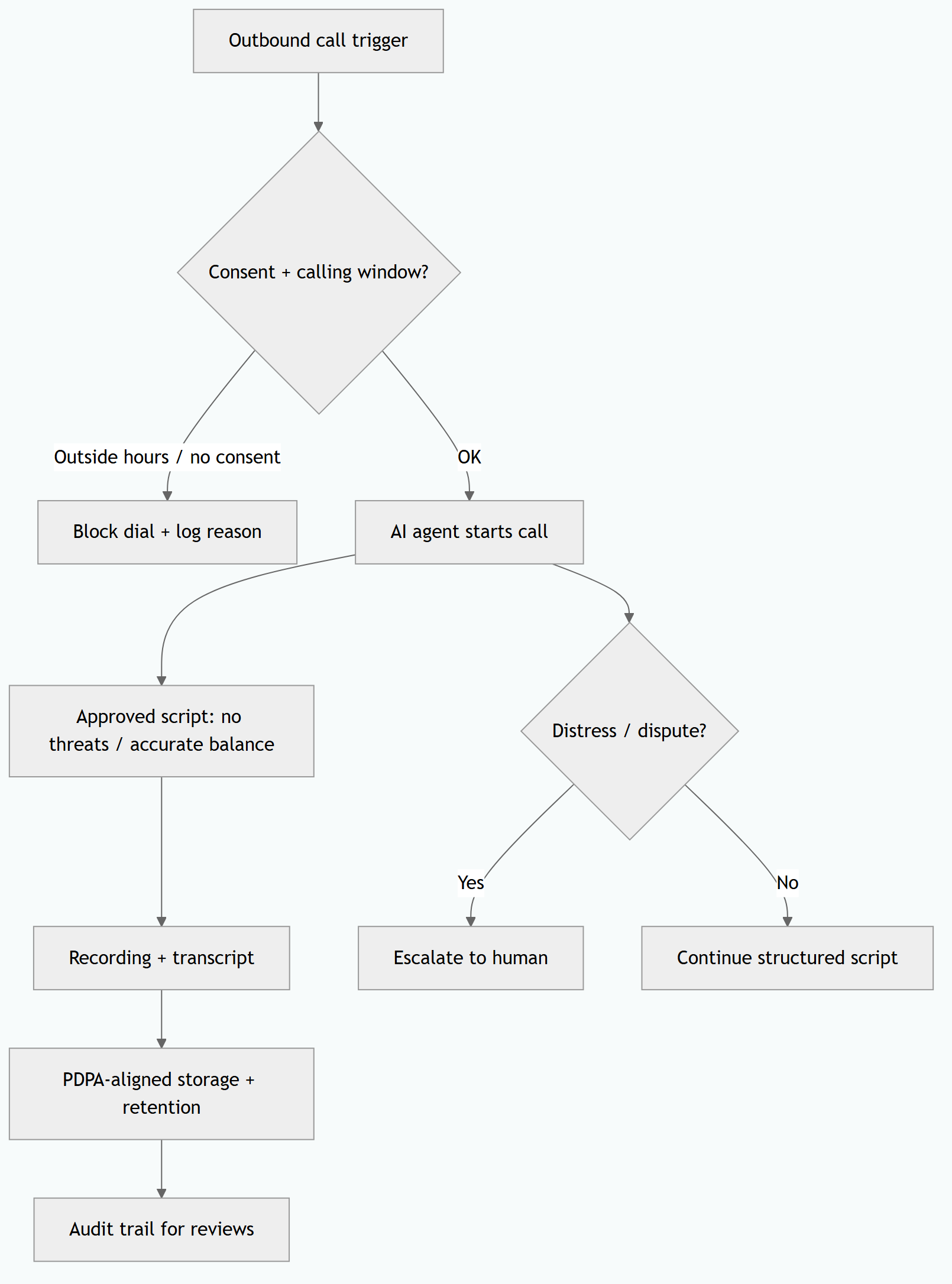
Key takeaway: A well-built AI collection agent is often easier to audit than a human floor — every call is transcribed, every script version is logged, and calling-hour violations become structurally hard rather than a training gap.
Deep dives in this cluster:
- BNM debt collection guidelines & AI calls
- Debt collection calling hours in Malaysia
- Email / notice before you call
- OTP phone verification before dialing
- Update loan T&Cs for AI collections consent
2. Recovery rate & ROI: AI vs human collection calls
Collections leaders care about cost per successful contact and recovery, not “AI” branding. For early-to-mid delinquency (roughly Day 1–90), the pattern looks like this:
| Metric | In-house human | Outsourced agency | AI voice (Suarify) |
|---|---|---|---|
| Cost per call | Highest | Medium | Usually lowest at volume |
| Capacity | Headcount-limited | Contract-limited | Scales with usage |
| Script consistency | Varies by agent | Varies by agent | Fixed + versioned |
| Multilingual (BM/EN/ZH/TA) | Hiring-dependent | Hiring-dependent | Built-in capability |
| Early-stage (Day 1–30) | Strong | Strong | Often comparable |
| Late / sensitive (90+) | Best | Best | First-touch + escalate |
The operating model that works: AI absorbs high-volume early reminders so humans spend time on accounts that need judgment.

Commercial deep dive: AI call center cost vs human agency in Malaysia
Journey / P2P playbooks: Delinquency call journey · Bucket-specific P2P scripts
3. Language & localization: why Manglish matters
Global “AI call center” vendors are often English-first with translated scripts bolted on. Malaysian borrowers respond differently.
- BM, English, Mandarin, Tamil — including natural code-switching, not PDF-sounding translation
- Tone by bucket — soft early reminders vs firmer (still compliant) mid/late asks
- Shame-sensitive conversations — many borrowers avoid calls out of embarrassment, not inability to pay; face-saving plans convert better than aggression
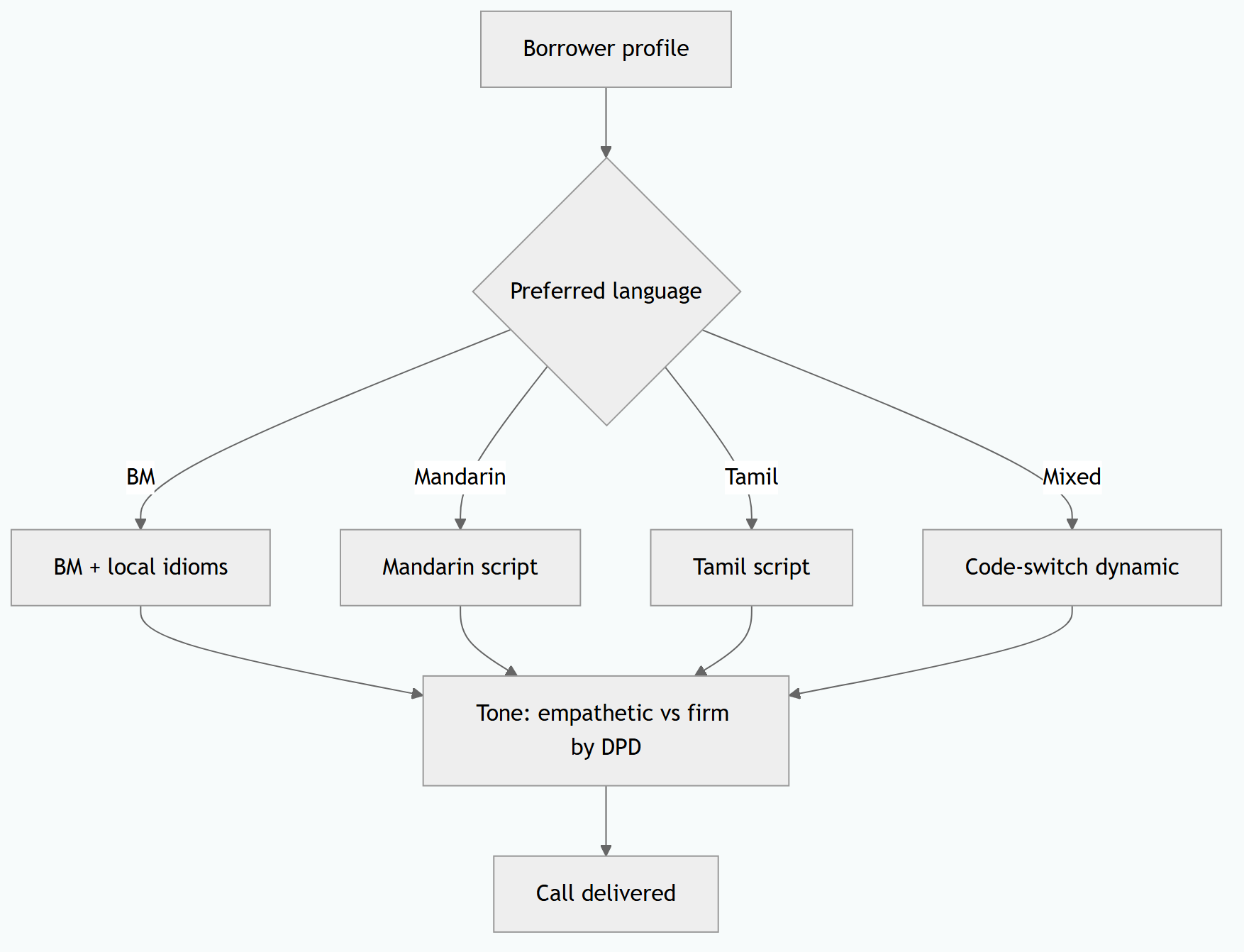
Vendor test: ask for live audio samples in all four languages — not a subtitled marketing video.
4. Ready-to-use call playbooks
P2P platforms usually need two AI workflows, not one.
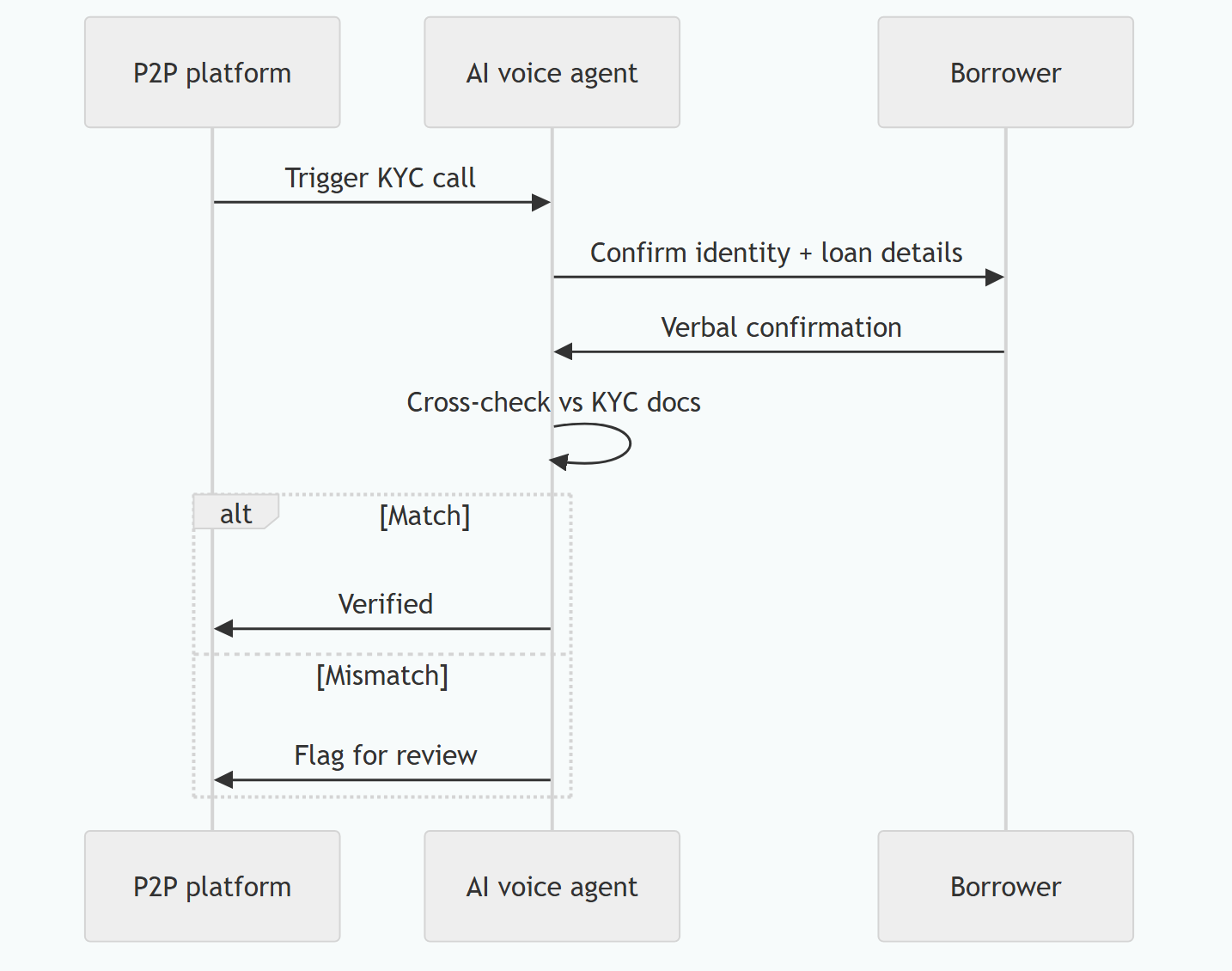
A. Onboarding / KYC verification
B. Segmented collections
| Segment | Approach | Owner |
|---|---|---|
| Day 1–7 | Friendly reminder | AI |
| Day 8–30 | Reminder + plan offer | AI |
| Day 31–60, no response | Firmer, multi-attempt | AI + review flag |
| Day 60–90+ | Negotiation / restructure | Human (AI prep) |
| Dispute / legal risk | Full handoff | Human only |
See also: Reduce collection complaints
5. Proof points & next steps
Before you buy, ask for:
- Anonymized pilot metrics (contact rate, P2P rate, kept-promise rate, cost per contact)
- A live Bahasa / Manglish collection demo
- CRM / LMS writeback proof (not spreadsheet exports only)
- Compliance controls: hours, consent, OTP, script versions, audit export

FAQ
Is it legal to use AI voice agents for debt collection calls in Malaysia?
Yes — provided the program follows market-conduct expectations (hours, tone, accuracy), handles personal data under PDPA 2010, and the lender remains accountable for agents (human or AI). AI does not remove obligations; it can make them easier to enforce consistently.
Can AI agents speak Bahasa Malaysia, Mandarin, and Tamil naturally?
Malaysia-built platforms like Suarify are designed for multilingual and code-switching conversations, which usually outperform English-only global stacks on local borrower response.
Does AI replace human collectors entirely?
No. AI is strongest on high-volume early reminders. Complex hardship, restructure, and legal-risk accounts still need humans — ideally with AI summaries and CRM context.
How much can a P2P platform save?
Savings depend on book size and current agency/seat costs. For early-stage volume, cost per successful contact is typically lower with usage-based AI than seat-based outsourcing. See the pricing breakdown.
What’s different about Suarify vs global AI call centers?
Localization + Malaysian operating context: languages, tone for shame-sensitive collections, and compliance controls (hours, consent, audit) designed as product features — not afterthoughts.
Cluster map: Cost vs human agency · BNM guidelines & AI · Calling hours · Email-first notices · OTP phone verify · T&C consent · Reduce complaints
Ready to test on your book? Explore Suarify or book a demo.