

Every lender, fintech, bank, telco, and BNPL operator eventually runs the same function: a collections department. Different brands, different scripts — but the delinquency journey is remarkably consistent.
This post maps the typical call path collectors take as accounts age: from a quiet first reminder, to interactive outreach, to right-party contact (RPC), then promise-to-pay (P2P) — and shows where Suarify closes the gap with dynamic call modes, self-serve P2P, and CRM API integration.
Every company has a collections department
Whether it sits under Risk, Operations, or Customer Success, collections exists to protect cashflow without destroying customer relationships.
A mature collections team usually balances three jobs at once:
- Reach the right person (not a wrong number, not a random household member)
- Match tone and ask to the delinquency stage (DPD bucket)
- Capture a usable outcome (reminder acknowledged, dispute logged, P2P, payment link used, escalate to human)
Manual dialers and static IVRs struggle because the journey is stage-based, not one-size-fits-all.
The typical delinquency journey (at a glance)

Call progression: from quiet nudge to commitment
1) First reminder — non-interactive
Goal: Notify early (often DPD 1–7 / early bucket) without friction.
Typical traits:
- One-way message or short automated voice drop
- No negotiation, no payment capture
- High volume, low cost per attempt
- Tone: helpful, factual, non-threatening
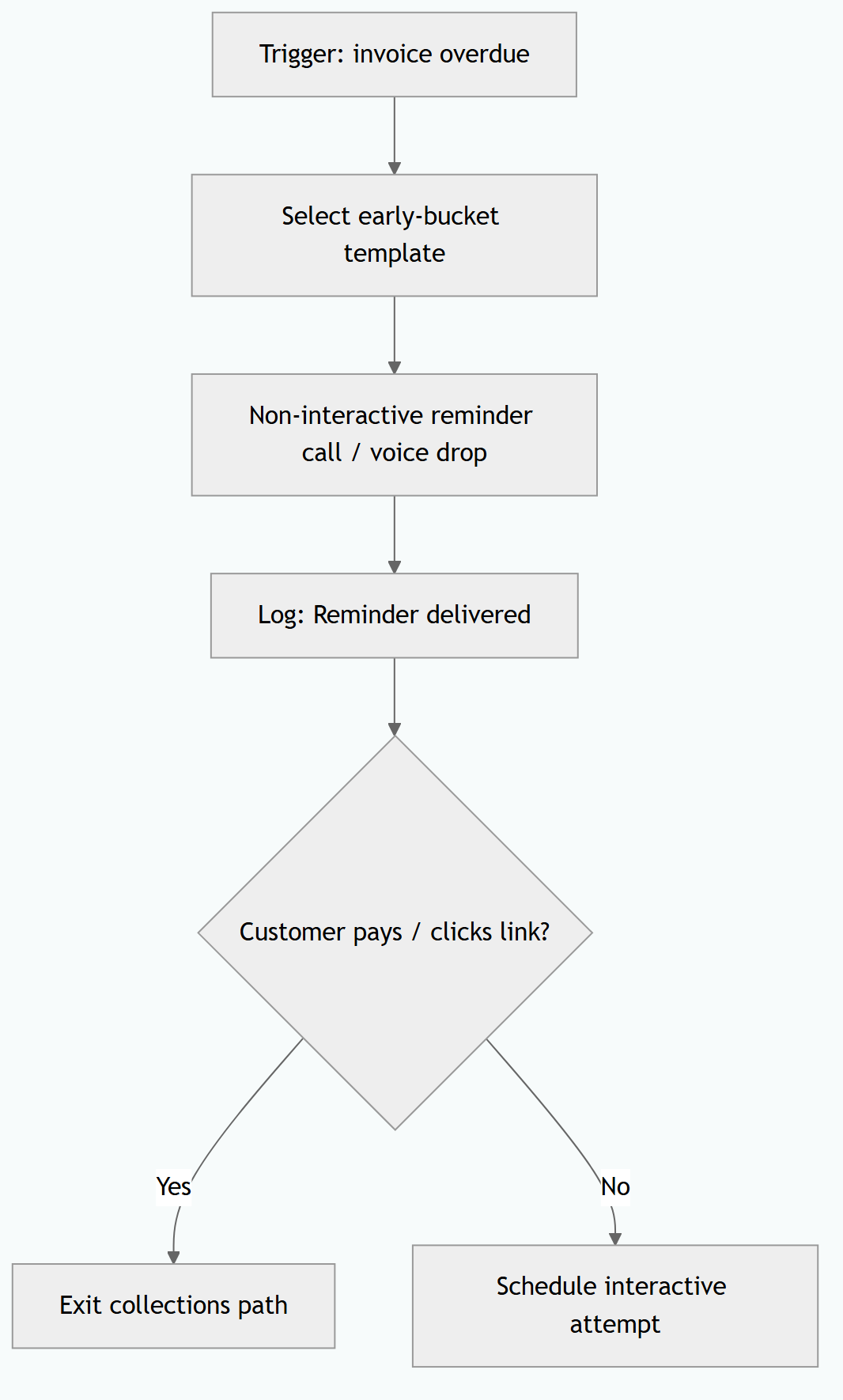
2) Interactive reminder — conversation begins
Goal: Confirm awareness, answer basic questions, offer channels to pay.
Typical traits:
- Two-way conversation (human or AI)
- Can handle “I already paid”, “wrong amount”, “need more time”
- Still light on hard commitments
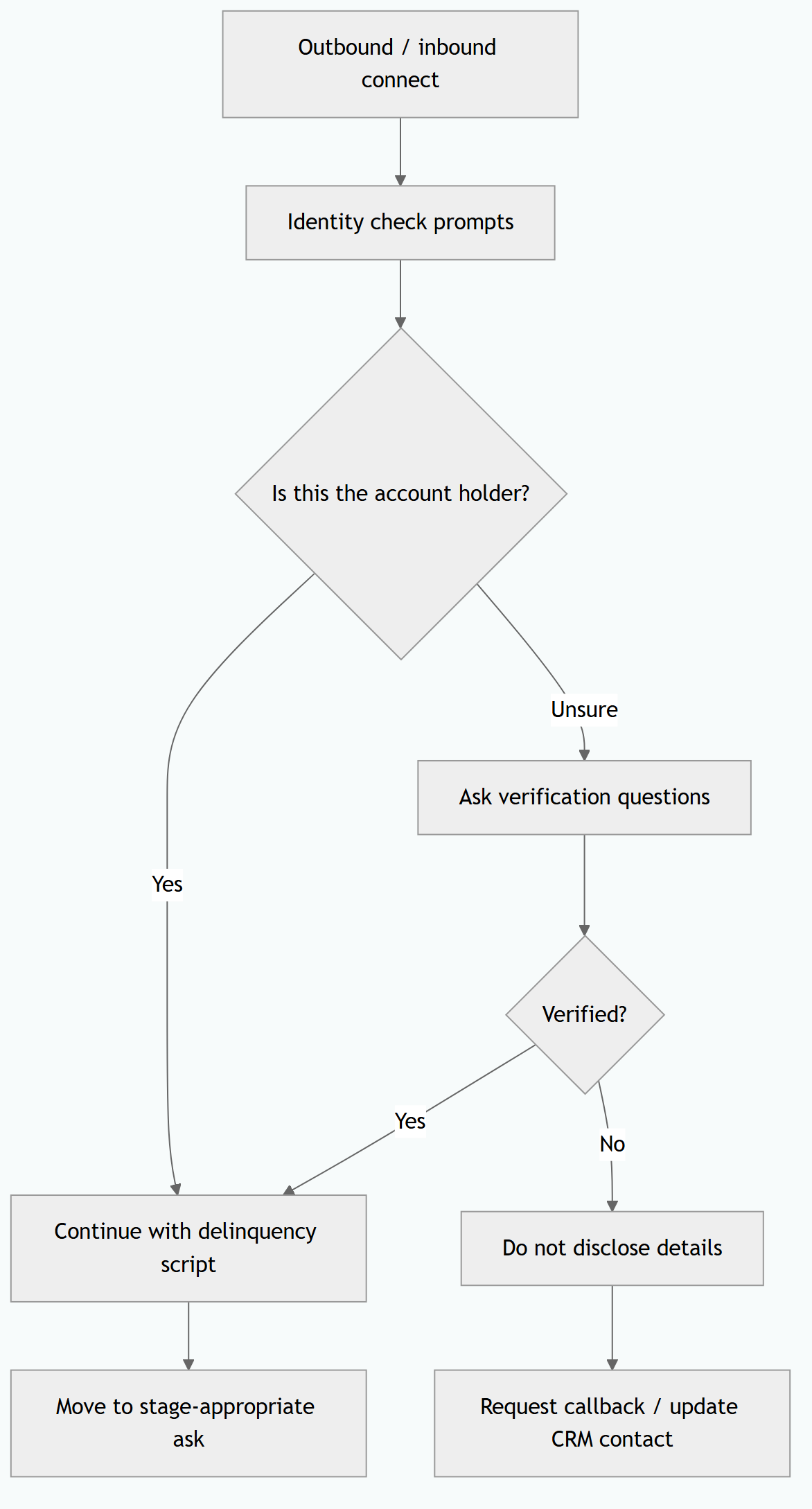
3) Right-party contact (RPC) — are we speaking to the right person?
Before deeper negotiation, good collections process verifies identity.
Goal: Avoid disclosing debt details to the wrong party; protect compliance and trust.
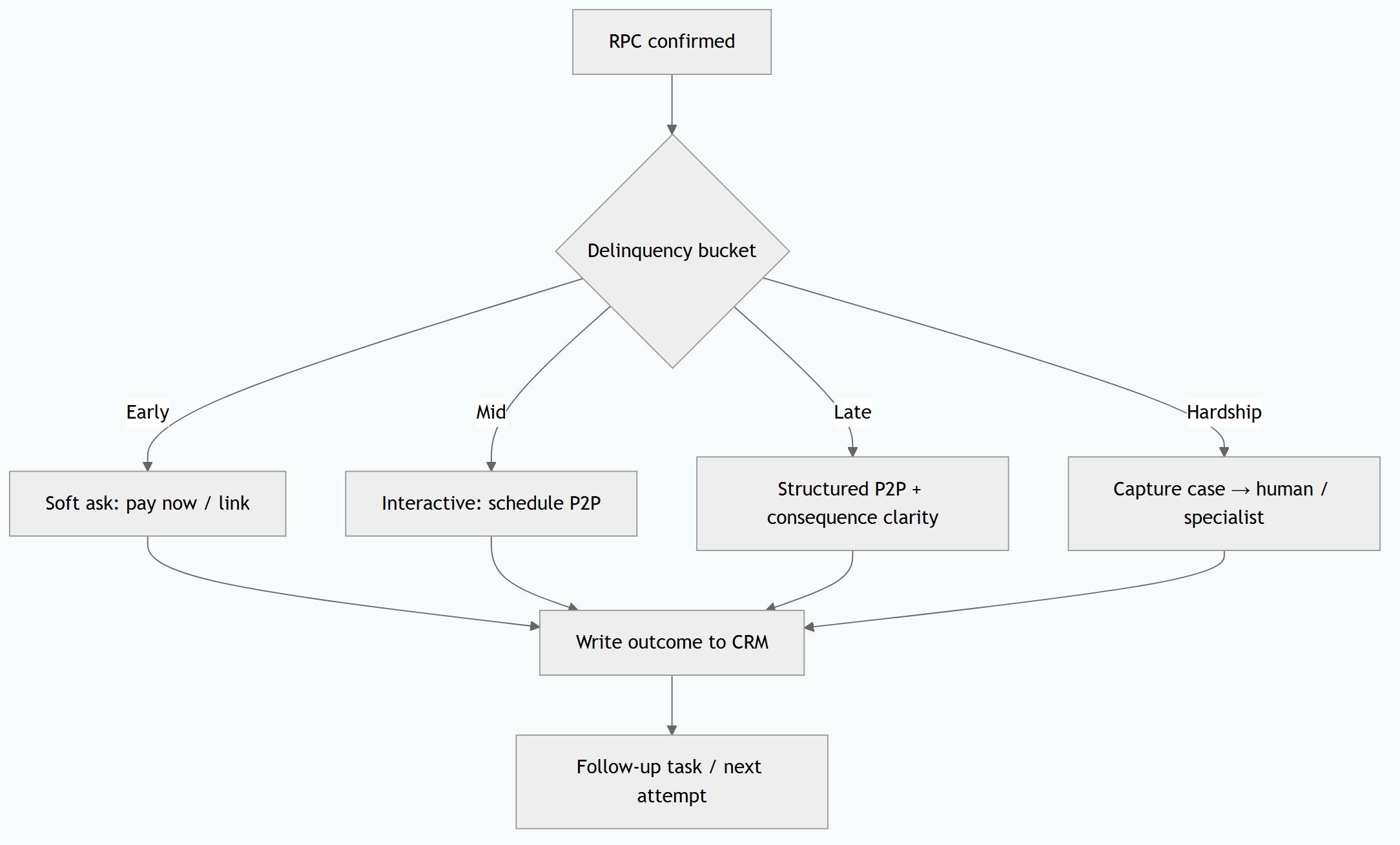
4) Promise-to-pay (P2P) — ask depends on delinquency
The ask should scale with risk and relationship:
| Bucket (example) | Typical ask | Tone |
|---|---|---|
| Early (e.g. 1–15 DPD) | Soft reminder + pay link | Helpful |
| Mid (e.g. 16–45 DPD) | Arrange date / partial / P2P | Firm but fair |
| Late (e.g. 46–90+ DPD) | Clear commitment, options, escalation path | Direct + documented |
| Hardship / dispute | Capture reason, pause, route to specialist | Empathetic |
Infographic: one journey, four call modes
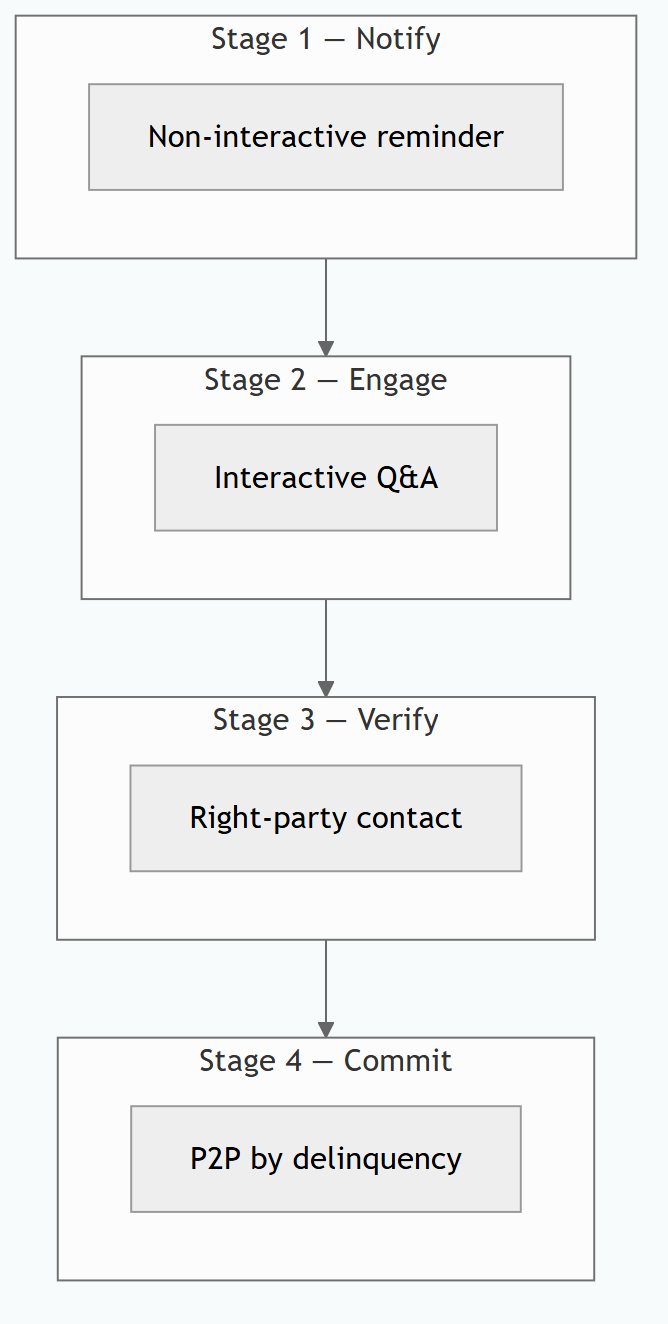
This is the “normal” operating model. The failure mode is also normal: wrong mode for the bucket, no CRM writeback, no payment path in-call, and humans burning time on early reminders.
Where teams feel the gap
- Static scripts don’t adapt when DPD changes mid-campaign
- RPC mistakes create compliance and reputation risk
- P2P lives in notes, not systems — so follow-ups drift
- CRM is after-the-fact — agents re-key outcomes
- Payment is a separate channel — customer hangs up and never opens the link
How Suarify bridges the collections gap
Suarify is built for stage-aware voice operations — inbound and outbound — so collections can run the journey above without duct-taping dialer + IVR + spreadsheet.
1) Dynamic mode: match the call to the delinquency stage
Use dynamic agent / routing configuration so the same campaign family can switch behavior by CRM fields (DPD bucket, product, language, prior P2P broken, dispute flag):
- Early bucket → non-interactive or ultra-short interactive reminder
- Mid bucket → conversational agent that can negotiate dates
- Late bucket → firmer script + escalation rules
- Hardship flag → transfer / human-in-the-loop
That is the difference between “blast dialer” and delinquency-aware voice AI.
2) Self P2P: capture commitment during the call
Instead of ending on “please pay when you can,” Suarify agents can guide customers toward a promise-to-pay:
- Confirm amount / due context (from CRM)
- Agree a date and channel
- Log structured outcome (not free-text only)
- Trigger the next follow-up automatically if P2P is broken
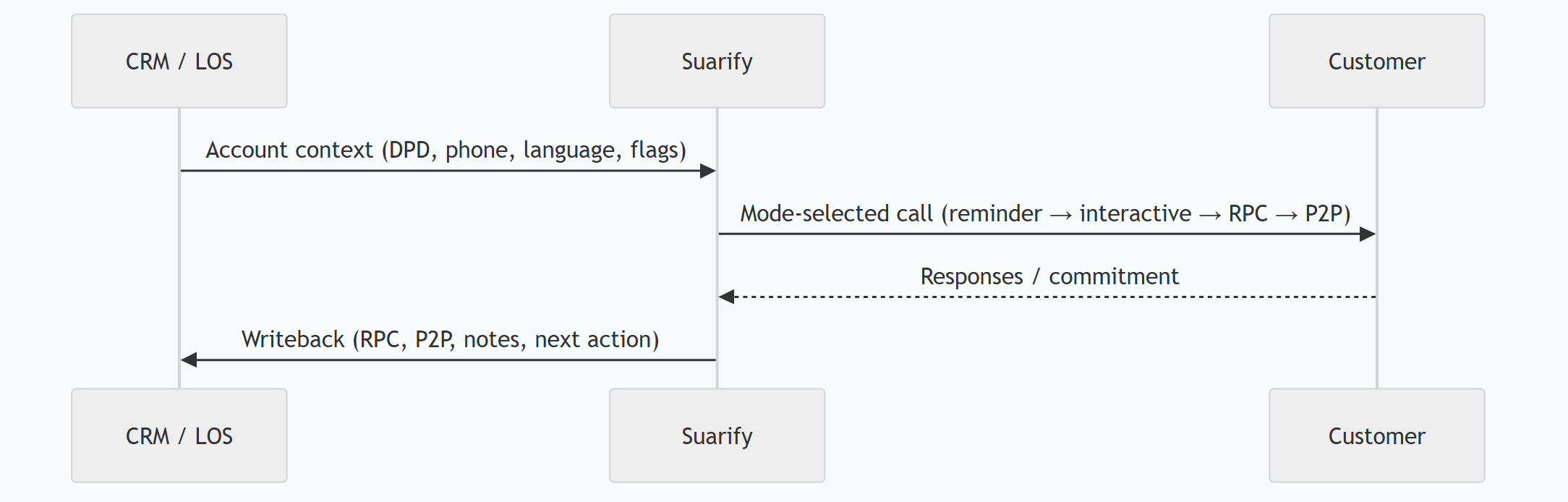
3) API integration to CRM: the call must write back
Collections only works if the system of record stays current. With Suarify’s developer API and CRM-oriented workflows, teams can:
- Pull lead/account context before dial (bucket, language, last outcome)
- Push call results: RPC yes/no, sentiment, notes, P2P date, value fields
- Keep inbound + outbound logs searchable for auditors and supervisors
4) Inbound + outbound in one operating model
Customers don’t only receive calls — they also call back after an SMS/reminder. Suarify covers inbound and outbound agents so the journey doesn’t break when the customer initiates contact.
Practical blueprint for a collections rollout
- Define buckets and allowed asks (compliance-reviewed scripts)
- Map each bucket to a Suarify mode (non-interactive / interactive / RPC / P2P)
- Connect CRM fields for eligibility + writeback
- Start with early-bucket reminder automation (fast ROI, lower risk)
- Expand to mid/late with P2P capture and supervisor dashboards
- Measure: contact rate, RPC rate, P2P rate, kept-promise rate, cash recovered
Closing
Collections is not “just more calls.” It is a journey of delinquency — notify, engage, verify, commit — repeated at scale.
Suarify helps teams run that journey with dynamic modes, self P2P, and CRM API integration, so every attempt moves the account forward instead of creating another unread note.
Next up: Bucket-Specific P2P Scripts — designing asks and broken-promise retries without sounding aggressive.
Ready to modernize collections outreach? Explore Suarify or book a demo.
Malaysia AI collections cluster: AI Voice Collections Malaysia (pillar) · BNM & AI compliance · Cost vs agency