


Executive summary (bottom-up)
- Solves: a text-to-speech model that is only 8 MB (about the size of two MP3 songs) and runs on a single CPU thread at ~25x real-time — fully offline, no GPU, no server, no API key. Ships as one int8 ONNX file.
- Where it runs: in a browser tab (Chrome/Edge/Firefox via WebGPU, WASM fallback) and on a backend in Python (onnxruntime, ~25x real-time on one thread). Same file, same weights, frontend and backend.
- Offline targets: kiosk terminals, clinic counters, plantation/depot Android phones, WhatsApp/IVR bots, accessibility readers — anywhere with no connectivity or no latency budget.
- Proof (benchmark): 5.5% median / 9.5% capped-mean CER on 200 Malay test sentences; 4.8% / 8.5% on a 60-sentence held-out set. Audio at 24 kHz mono.
- The gap it fills: there was no small, Kokoro-class Malay (Bahasa Melayu) or Indonesian (Bahasa Indonesia) TTS that runs on both backend and frontend web using JavaScript and Python. Existing options are 100 MB+ or cloud-only.
- Voices: Yati (female, recommended) and Michael (male). License: Apache-2.0.
Why this exists: searching for “Kokoro Malay” and finding nothing
If you search for a small Kokoro Malay text-to-speech model, you will not find one. The author could not find any Kokoro (or Kokoro-class) model for Bahasa Melayu or Bahasa Indonesia that is small enough to run on a CPU and in a browser. The closest options were hundreds of megabytes, GPU-bound, or locked behind a cloud API. That gap is why Kecil-TTS exists: a Kokoro-inspired, 8-million-parameter model built specifically to be the smallest usable Malay TTS that actually runs on CPU and in the browser. Kecil (“small” in Malay) is the whole point — a model the size of two MP3 files that you can cache once and run offline on a kiosk, a phone, or a backend worker.
We searched for Kokoro Malay, Kokoro Indonesian, small Malay TTS, Bahasa Melayu text-to-speech, Bahasa Indonesia TTS, 8M TTS, lightweight TTS, browser TTS, offline TTS Malaysia, open source Malay voice, onnx malay tts, transformers.js tts and researched but did not actually find any actual model result. hence we make our own malay tts model and named it kecil tts because this is possibly the first malaysia record for smallest (700mil param 8mb model) malaysian tts model in malaysia that can run on webgpu (browser) and also backend like python.

Quick answer: Kecil-TTS is a free, open-source Malaysian Malay (Bahasa Melayu) text-to-speech model that weighs only 8.5 MB and runs entirely in a browser tab. It has 7.9 million parameters, two voices (Yati, female; Michael, male), outputs 24 kHz audio, and ships on HuggingFace under Apache-2.0. No GPU, no server, no API key required.
Why a “kecil” (small) TTS?
Most modern TTS models are heavy: hundreds of megabytes, GPU-bound, cloud-only. That is fine for a data centre, but useless for a Malaysian SME that wants a voice on a cheap Android phone, an offline kiosk, or a WhatsApp bot with no latency budget. Kecil-TTS (“kecil” = small in Malay) is built for the opposite end of the spectrum: a model small enough to download once, cache in the browser, and run on a single CPU thread.
It is a Kokoro-style architecture distilled down to 8M parameters, exported to a single int8 ONNX file, and made WebGPU-safe so it runs in Chrome/Edge/Firefox via transformers.js — with a WASM fallback where WebGPU is unavailable.
What it is
| Spec | Value |
|---|---|
| Parameters | 7.9 M |
| Model file | 8.46 MB (int8 ONNX, single file) |
| Output | 24 kHz mono WAV |
| Speed | ~25x real-time on one CPU thread (onnxruntime); ~15x in a browser tab on WebGPU |
| Language | Bahasa Melayu (Malaysia), plus ~430 common English words used in Malaysian speech |
| Max input | 402 phonemes per call (long text is split at sentence ends) |
| Voices | Yati (female, default) and Michael (male) |
| License | Apache-2.0 (code + weights) |
| Base model | Paradee-8M-v1.3 (Sahil Mahendrakar) |
The two voices are separate model checkpoints sharing the same architecture:
- Yati (female) — kecil-tts-yati-v0.4.1 (recommended). Cleaner sound than v0.4, same recognition accuracy.
- Michael (male) — kecil-tts-michael-v0.2. First release; understandable but more errors than Yati.

Benchmarks: how good is it?
Quality is measured by playing the model’s speech to Whisper large-v3 and comparing what it heard with the source text — character error rate (CER), lower is better. The recogniser itself misreads ~9% of the training clips, so no model scores zero; treat differences under ~1.5 points as noise.
200 test sentences (median / capped-mean CER)
| Category | n | v0.2 | v0.3 | v0.4 / v0.4.1 |
|---|---|---|---|---|
| General text (Wikipedia-style, names, places) | 70 | 9.9 / 13.1 | 6.4 / 11.2 | 5.9 / 10.2 |
| Call-centre style (appointments, bills, delivery) | 60 | 5.2 / 6.5 | 4.9 / 7.3 | 4.3 / 6.2 |
| Numbers and money | 30 | 5.0 / 6.5 | 0.0 / 5.8 | 2.2 / 6.0 |
| Malay with English words | 20 | 18.4 / 23.9 | 19.2 / 26.2 | 17.9 / 24.9 |
| Questions | 10 | 1.7 / 3.3 | 0.0 / 2.4 | 0.0 / 4.3 |
| Short phrases | 10 | 13.5 / 15.9 | 0.0 / 15.4 | 4.0 / 10.2 |
| Overall | 200 | 7.5 / 10.8 | 5.9 / 10.5 | 5.5 / 9.5 |
Held-out set (60 sentences): v0.4 scores 4.8% median / 8.5% capped mean — the best of the three on unseen text, which is the number that matters most in production.
Sound texture (v0.4.1 vs v0.4)
v0.4.1 is an export-only fix: the breath noise is moved out of the harmonic bins into the gaps between them in voiced frames, and the burst-noise path is gated to unvoiced frames. Measured against a Chatterbox reference:
| Metric | Chatterbox ref | v0.4 | v0.4.1 |
|---|---|---|---|
| Periodicity | 0.699 | 0.745 | 0.750 |
| Spectral flatness 2–6 kHz | 0.621 | 0.698 | 0.598 |
| Energy share >4 kHz | 0.080 | 0.040 | 0.032 |
Flatness now sits just below the reference (noise concentrated between harmonics) instead of above it (noise smeared over them) — the “watery” texture is reduced.
How it was made
- A rule-based Malay front end writes Malay as phonemes in the 178-symbol vocabulary of Kokoro-82M.
- ~750 Malay sentences were synthesised with Chatterbox Multilingual and voice-converted to the target speaker using a Kokoro
am_michaelreference read. - The 8M-parameter architecture and training recipe are those of Paradee-8M, trained in under an hour on one T4 GPU.
- Weights were exported to ONNX (opset 17) with int8 quantisation and made WebGPU-safe (no float64 operators).
v0.4 added ~69 minutes of newly generated clips (295 general, 136 Malay+English, 174 conversational, 142 with numbers, 20 questions) on top of the cleaned v0.3 set, bringing the training corpus to 1,281 aligned sentences.
Use cases
- Browser-based voice for Malaysian SMEs — TTS on a product page, FAQ bot, or WhatsApp flow with no backend and no per-character cost.
- Offline / low-connectivity apps — model caches after first load; works on a phone in a clinic, plantation, or delivery depot.
- Call-centre IVR & outbound — short prompts (confirmations, reminders, amounts) in Malay with acceptable CER on call-centre-style text (4.3% median).
- Accessibility — read-aloud for Malay content on news, government, and education sites.
- Embedded / edge devices — 8.5 MB fits on a Raspberry Pi or microcontroller-class board; single-thread CPU inference at ~25x real-time.
- Research & prototyping — Apache-2.0 weights, runnable Python (onnxruntime only, no PyTorch) and Node/JS front ends.
Limitations (read before shipping)
- English words are the weak spot — Malay+English sentences score ~18% CER. Only ~430 common English words are handled; more training audio did not move this number.
- One synthetic female voice (Yati) with no emotion or style control; Michael (male) is less accurate.
- Short sentences only — long text is split at sentence ends (max 400 phonemes per call).
- High-frequency damp is inherited from training — v0.4.1 removes the watery texture but overall brightness is still below the Chatterbox reference; a faint watery tail can remain at sentence ends.
- Synthetic speech — please disclose that it is AI-generated when you use it.
- Numbers, amounts, dates, times and phone numbers are read out in Malay by a rule-based normaliser.
Getting started
Python (onnxruntime + numpy, no PyTorch):
pip install onnxruntime numpy huggingface_hub soundfile
pip install https://huggingface.co/Suarify/kecil-tts-yati-v0.4.1/resolve/main/dist/suaradee-0.4.1-py3-none-any.whl
import soundfile as sf
from suaradee import SAMPLE_RATE, Suaradee
tts = Suaradee.from_pretrained("Suarify/kecil-tts-yati-v0.4.1")
sf.write("hello.wav", tts("Selamat pagi, boleh saya bantu encik hari ini?"), SAMPLE_RATE)Browser / Node (transformers.js 3.x):
import { Suaradee } from './js/suaradee.js';
const tts = await Suaradee.load({ model: 'Suarify/kecil-tts-yati-v0.4.1', g2pBase: './js/g2p/' });
const { audio, sampleRate } = await tts.speak('Selamat pagi, boleh saya bantu encik hari ini?');
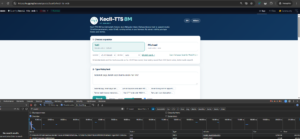
Try it live: Kecil-TTS web Space (nothing leaves your device).
Links
- Space (demo): huggingface.co/spaces/Suarify/kecil-tts-web
- Yati v0.4.1 (recommended): huggingface.co/Suarify/kecil-tts-yati-v0.4.1
- Michael v0.2 (male): huggingface.co/Suarify/kecil-tts-michael-v0.2
- Base architecture: Paradee-8M
CTA: Building a Malay voice feature? Try Kecil-TTS in your browser and tell us what breaks — suarify.my