
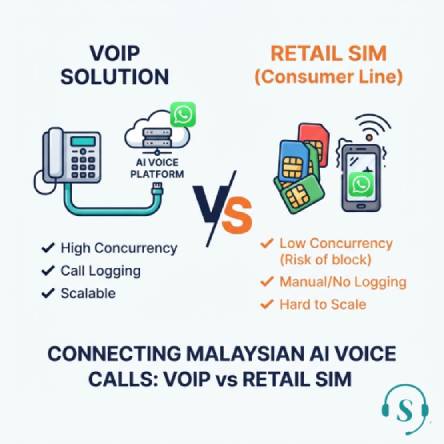
Quick answer: A retail SIM is a consumer mobile number from a telco (CelcomDigi, Maxis, U Mobile, etc.) sitting in a phone or USB modem. VoIP / SIP trunking is a business phone number delivered over the internet to software (or a gateway) — no plastic SIM required on every agent PC. For AI voice outbound/inbound in Malaysia, VoIP usually wins on scale, call concurrency, logging, and cost-per-minute; retail SIMs still appear when teams want “a normal Malaysian mobile that looks local,” or when a channel (e.g. WhatsApp) needs a number that can receive a voice OTP. Many AI stacks can support both: cloud SIP and a physical SIM on a gateway device — with clear trade-offs.
This post answers the questions Malaysian buyers ask Suarify most often: difference, pros/cons, hybrid AI setups, pricing shape, and whether WhatsApp works on VoIP.
Table of contents
- VoIP vs retail SIM — plain English
- Pros and cons
- AI voice can use both (cloud SIP + on-device SIM)
- How pricing usually compares
- Can you use WhatsApp on a VoIP number?
- MicroSIP (or equivalent): prove the number can receive calls
- FAQ
1. VoIP vs retail SIM — plain English
| Retail SIM | VoIP / SIP | |
|---|---|---|
| What it is | Consumer mobile service on a physical SIM | Business telephony over IP (SIP trunk / hosted PBX / DID) |
| How calls connect | Radio network via handset / modem / gateway | Internet → SIP client / AI platform / SBC |
| Typical identity | Personal-looking mobile (01x…) | Mobile DID or geographic / toll-free style numbers (provider-dependent) |
| Best for | One agent, low volume, “phone in pocket” | Many concurrent AI/human calls, CRM logging, scale |
| Hardware | Phone or USB dongle + SIM | Softphone / AI cloud / optional gateway |
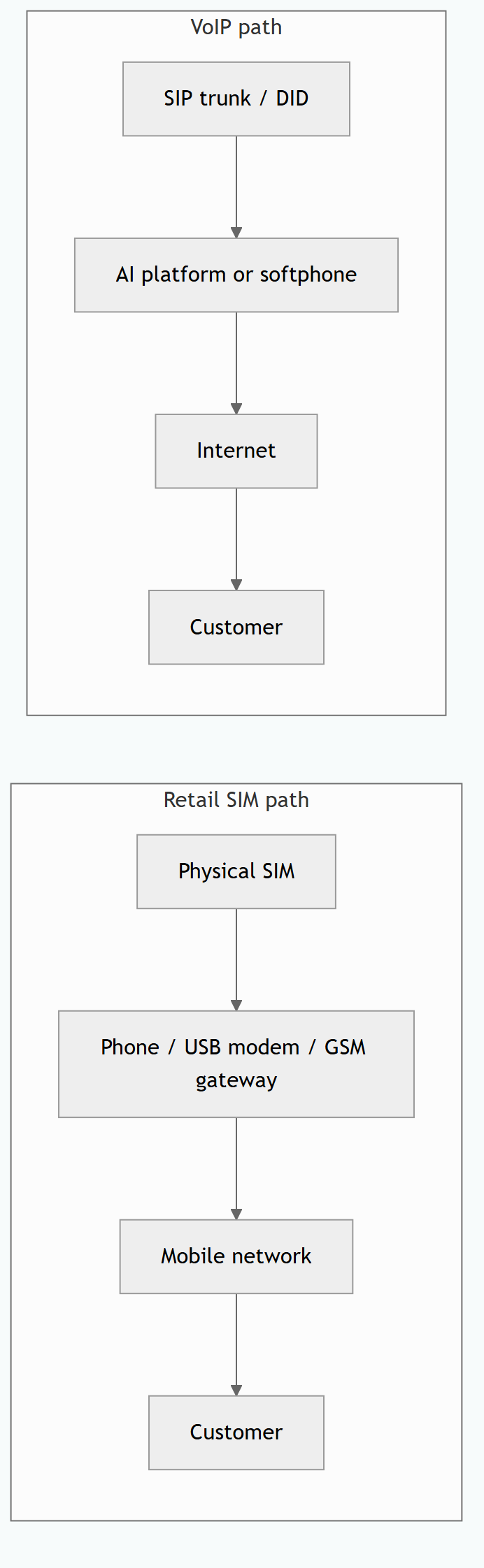
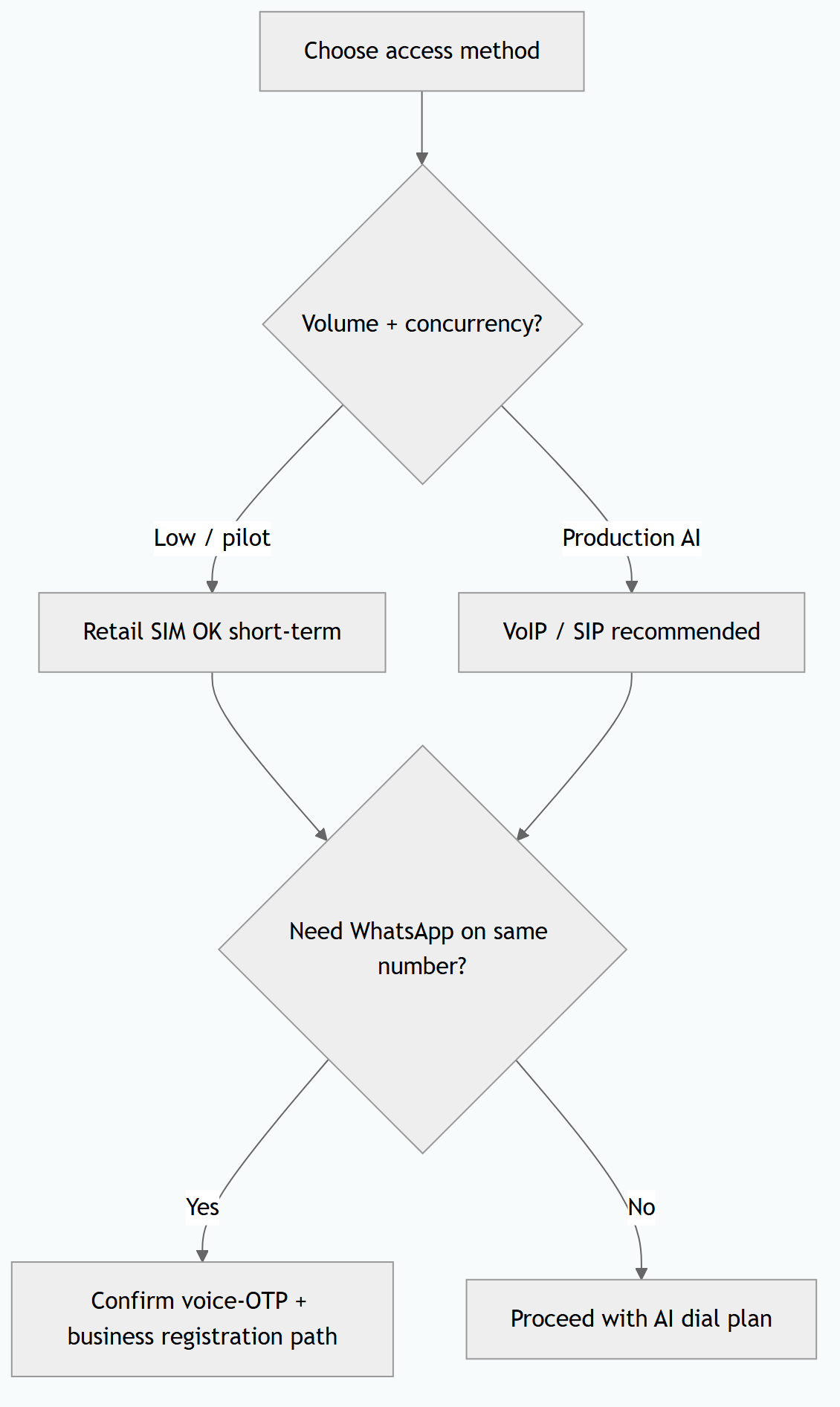
Rule of thumb: if you are running AI outbound campaigns, inbound IVR replacement, or a small call floor, start from VoIP. Keep retail SIMs for niche channel needs or temporary pilots — not as your only scale path.
Related reading: AI call center cost vs agency · AI voice collections pillar
2. Pros and cons
Retail SIM — pros
- Familiar Malaysian mobile CLI (caller ID) for some customers
- Easy to buy and top up
- Works offline from “cloud” if the radio path is up (handset still needs coverage)
- Sometimes preferred for WhatsApp personal / Business app registration experiments
Retail SIM — cons
- Concurrency is painful — one SIM ≈ limited simultaneous calls without a multi-SIM gateway farm
- Physical ops: SIMs, dongles, USB ports, driver issues, SIM bans / KYC churn
- Weak audit story vs cloud call detail records (CDR)
- Scaling AI means more hardware, not just more minutes
- Risk of consumer ToS issues if used for heavy commercial blasting
VoIP / SIP — pros
- Scale concurrent AI calls without stacking USB modems
- Cleaner integration into CRM / LMS writeback
- Easier recording, transcription, and compliance logging
- Number provisioning and failover are software problems
- Usually clearer business commercial terms
VoIP / SIP — cons
- Needs stable internet and proper SIP credentials
- Number type / CLI reputation varies by provider (vet before buying bulk)
- Some apps (notably WhatsApp) are picky about number eligibility and verification method
- Misconfigured SIP = one-way audio, NAT issues — fixable, but needs a short setup discipline
3. AI voice can use both (cloud SIP + on-device SIM)
Suarify-style AI voice stacks often support two termination modes:
A) Cloud / SIP (preferred for production)
AI platform registers to your SIP trunk (or ours). Calls stay in software. No plastic SIM on the agent laptop.
B) On-device / gateway with a physical SIM
Some deployments place a GSM gateway or USB modem near a PC so the AI (or a bridge) places calls “as” that retail SIM.
That works — with real limits:
| Constraint | Why it matters |
|---|---|
| Computer / gateway must stay on | Power loss = no dial tone for that SIM path |
| Physical SIM + radio coverage | Relocation, roaming, and hardware failure become ops tickets |
| USB / driver fragility | Not what you want under a 9 a.m. collections wave |
| Concurrent calls | Extra SIMs / channels = more boxes, cables, and monitoring |
| Security & premises | The dialer endpoint is now a device in a room, not only a cloud ACL |

Practical recommendation: use SIP for day-to-day AI volume; use on-device SIM only when a specific number identity or channel requirement forces it — and treat that machine like production infrastructure (UPS, monitoring, remote access).
4. How pricing usually compares
Exact ringgit rates change by provider and commitment. Compare shapes, then ask for a quote on your attempt volume.
| Cost element | Retail SIM path | VoIP / SIP path |
|---|---|---|
| Access | Prepaid/postpaid plan + top-ups | Channel / DID fee + per-minute |
| Hardware | Phones, multi-SIM gateways, spares | Softphone or included in AI platform |
| AI platform | Usage (per call / minute) still applies | Same — plus SIP connectivity |
| Failure cost | Manual SIM swaps, site visits | Usually remote config / failover |
| At high volume | Hardware + SIM sprawl dominates | Minutes + concurrency dominate |
For AI collections / reminders, the expensive mistake is optimizing only prepaid SIM tariff while ignoring agent time, concurrency, and failed attempt ops. See also cost vs human agency.
Ask vendors for: blended cost per connect, max concurrent calls included, CLI options, recording retention, and WhatsApp-related constraints if you need the same number for chat.
5. Can you use WhatsApp on a VoIP number?
Short answer: often yes — if the number can complete WhatsApp’s verification and your business use is properly set up.
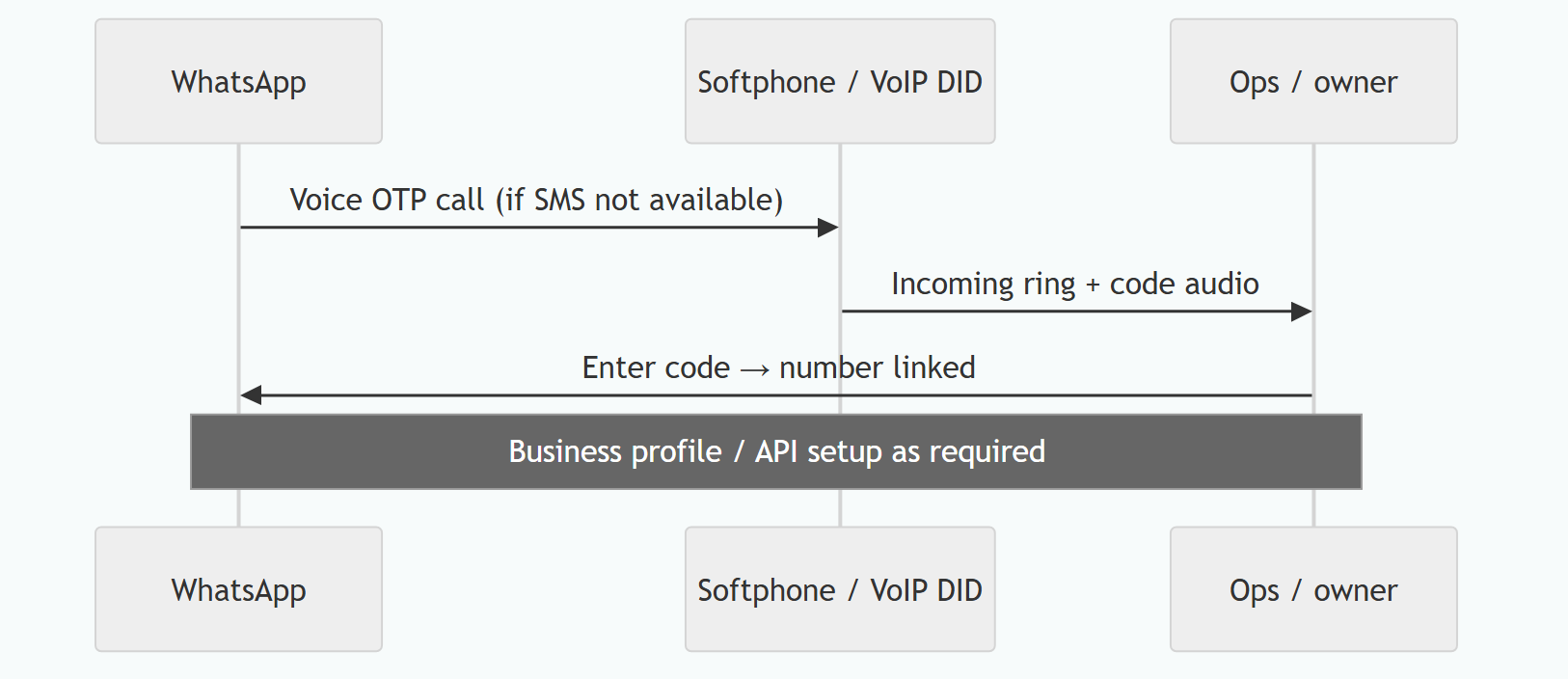
WhatsApp verification historically prefers SMS OTP, but when SMS is unavailable many flows allow voice call OTP. That is why softphone proof matters: if MicroSIP (or any SIP client) can receive the inbound verification call and you hear the code, you can usually finish registration without SMS.
Business reality (do not skip):
- For serious commercial messaging, plan around WhatsApp Business / WhatsApp Business Platform (API) with a registered business (proper legal entity, Meta Business verification where required) — not a random personal account used as a blast channel
- Number eligibility, country rules, and Meta policy change; always check current WhatsApp / BSP requirements
- Voice AI calling and WhatsApp messaging are related channels, not the same product — you may use one number for both, or separate numbers by design
6. MicroSIP (or equivalent): prove the number can receive calls
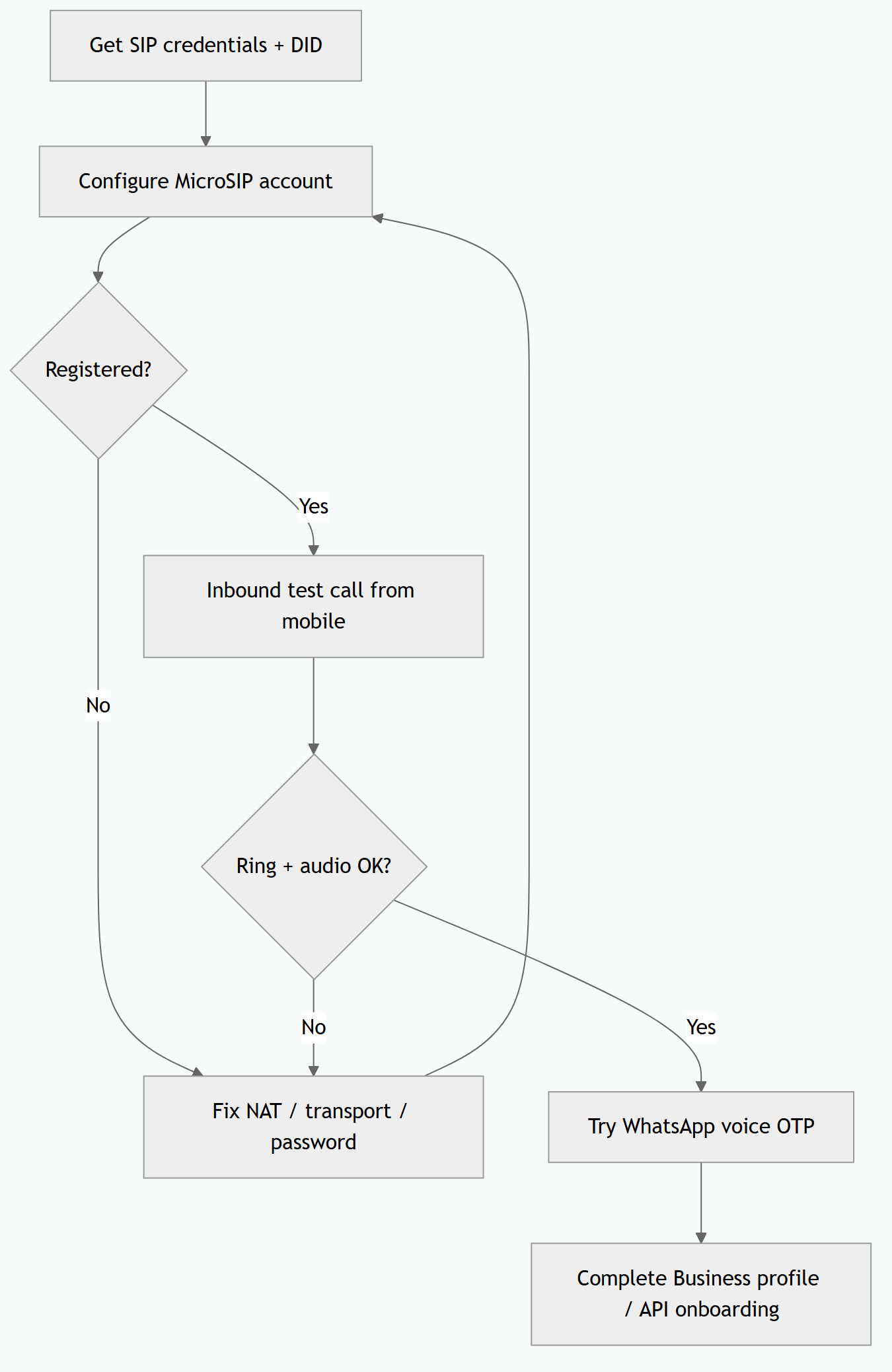
Before you bet a customer journey on “this VoIP number works for WhatsApp,” do a receive-call smoke test with a free SIP softphone such as MicroSIP (Windows) or an equivalent client on your OS.
Setup checklist (typical SIP account)
- Install MicroSIP (or Linphone / Zoiper / similar)
- Add account with your provider fields:
– SIP server / domain
– Username / auth ID
– Password
– Often: outbound proxy, transport (UDP/TCP/TLS), and local port - Confirm registration status shows online / registered
- Call the DID from a mobile — softphone must ring and answer with two-way audio
- Only then attempt WhatsApp voice OTP on that same number
What “screenshots” should show your team (or vendor)
When we walk customers through this, the proof pack is usually:
- Account / SIP settings screen — server, user, transport (password blurred)
- Registered / online status
- Incoming call UI during a test ring
- WhatsApp verification choosing “Call me” (when SMS is not offered)
- Business profile showing the verified number after success
If you are evaluating Suarify, ask for a live screen-share of the same flow on a Malaysia-reachable test DID — seeing registration + inbound ring removes half the VoIP anxiety in one sitting.
Compliance note: registering WhatsApp for business messaging should follow Meta’s terms and Malaysian business registration / disclosure norms. Do not use consumer workarounds that violate platform rules.
FAQ
Is VoIP legal for business calling in Malaysia?
Businesses commonly use licensed SIP/trunk providers and hosted PBX services. Choose reputable providers, keep proper commercial agreements, and align calling conduct with your sector rules (e.g. collections hours). This is not legal advice — confirm with your telco counsel for regulated use cases.
Will customers trust a VoIP caller ID?
Trust depends on CLI reputation and your script — not “SIP vs SIM” alone. Test answer rates on a small sample before scaling.
Can Suarify use my existing SIP trunk?
AI voice platforms typically bring-your-own-SIP or offer bundled termination. The right choice depends on your numbers, concurrency, and recording needs.
Do I need a physical SIM for AI voice?
No for most production AI. Yes only when a specific SIM identity / gateway path is required.
Can WhatsApp verify via missed call / voice instead of SMS?
When WhatsApp offers voice verification, a VoIP number that can receive the OTP call can complete signup. Business use still needs proper Business / API registration.
Also useful: BNM & AI collections compliance · Calling hours · OTP before collection calls
Ready to test SIP + AI on your book? Explore Suarify or book a demo — we can walk MicroSIP registration and inbound receive-call proof live.