
In Post 1 we mapped the delinquency call journey: remind → engage → verify right-party contact → ask for a promise-to-pay (P2P).
This post goes one level deeper: how the P2P ask should change by delinquency bucket, and how to design broken-promise retries that stay firm, compliant, and human — then how Suarify automates that ladder with dynamic modes and CRM writeback.
Why one P2P script fails at scale
Collectors often reuse a single “can you pay by Friday?” line across every account. That creates three predictable failures:
- Early accounts feel attacked — relationship damage for a small delay
- Late accounts hear soft language — no clear commitment, no consequence clarity
- Broken promises get the same script again — customer learns that saying “yes” buys silence
A modern collections playbook treats P2P as a stage-aware negotiation, not a slogan.
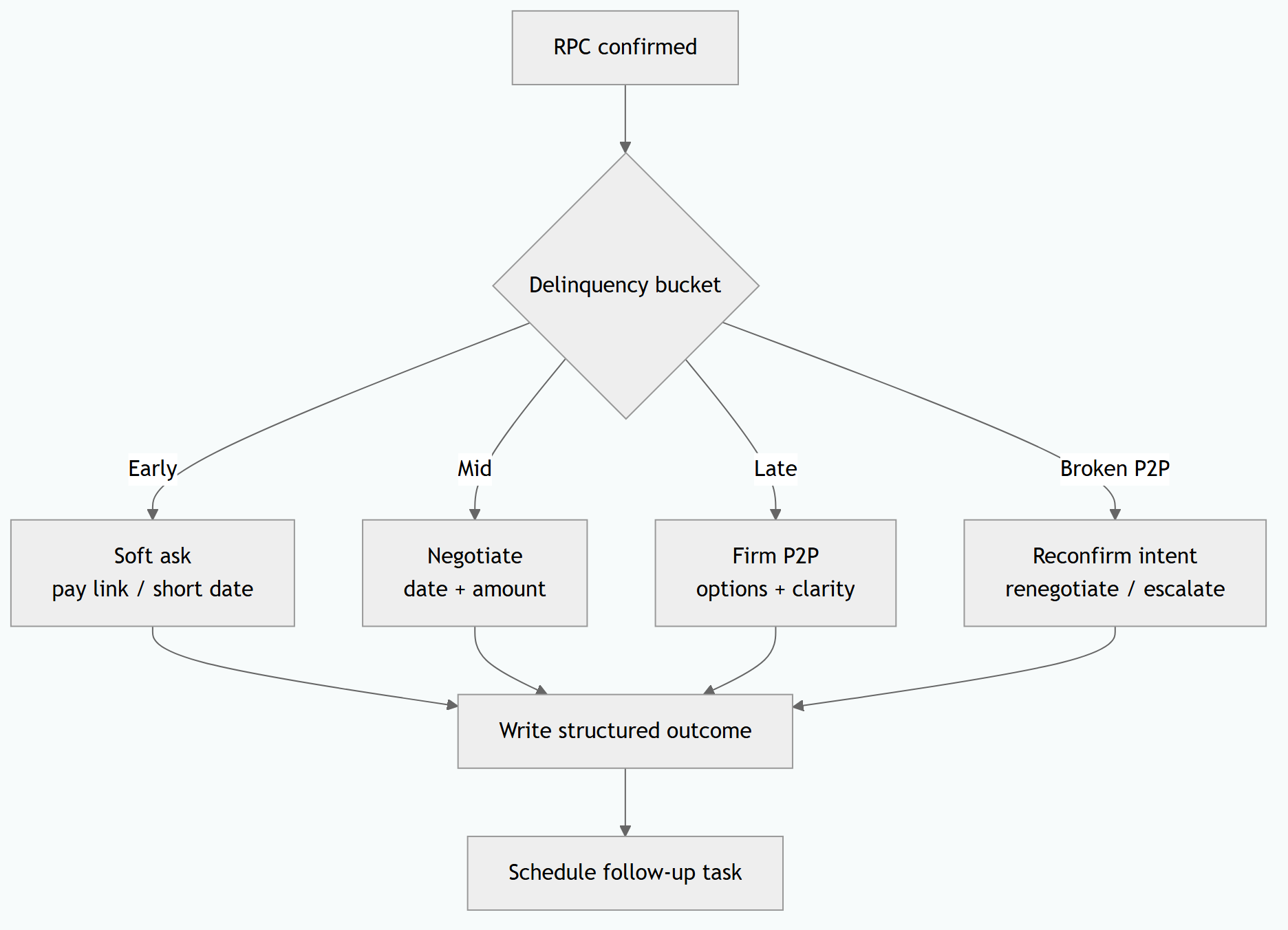
The P2P ladder by delinquency bucket
Use your own DPD ranges and compliance rules. The pattern below is the industry shape most teams converge on:
| Bucket | Goal of the call | Primary ask | What “good” looks like |
|---|---|---|---|
| Early (e.g. 1–15 DPD) | Awareness + easy pay path | Soft P2P or pay-now link | Reminder acknowledged / link used |
| Mid (e.g. 16–45 DPD) | Dated commitment | Full / partial P2P with date | Structured P2P in CRM |
| Late (e.g. 46–90+ DPD) | Clear commitment + options | Firm P2P, hardship route, escalate path | Documented outcome + next action |
| Broken promise | Re-engage without restarting from zero | Reconfirm, renegotiate, or escalate | Kept-promise recovery or new plan |
Script design principles (keep the human tone)
Regardless of bucket, strong P2P scripts share the same skeleton:
- Context — why you’re calling (amount / due reference from CRM)
- Listen — dispute, hardship, “already paid,” wrong party
- Ask matched to bucket — soft → negotiated → firm
- Close the loop — date, channel, confirmation language
- Writeback — structured fields, not only free-text notes
Tone rule of thumb: be clear, not theatrical. Aggression is optional; ambiguity is expensive.
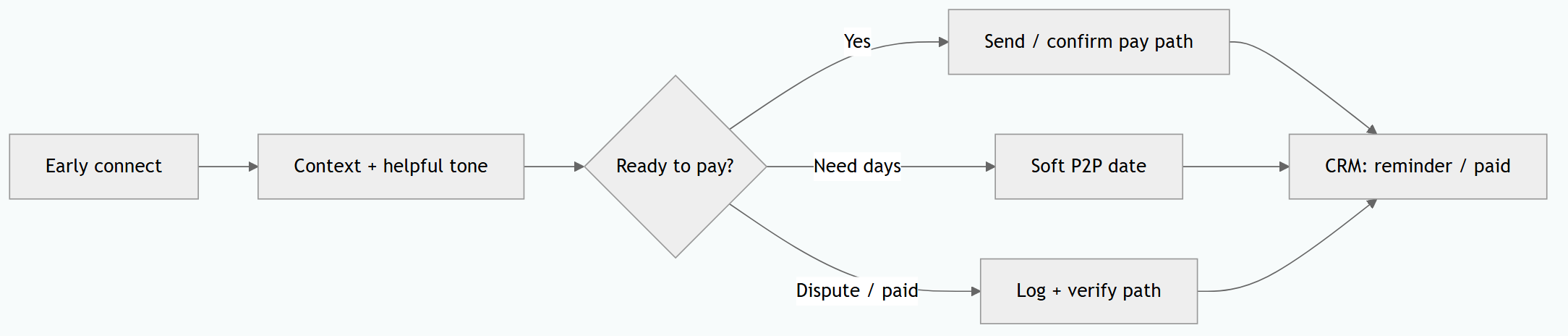
Early bucket — soft P2P
Intent: Make paying easy. Don’t open with consequences.
Typical moves:
- Confirm they received the invoice / statement
- Offer the pay link / app / bank reference
- If they need a few days: capture a light P2P (“by Tuesday is okay?”)
- Thank and exit quickly when paid or arranged
Mid bucket — negotiated P2P
Intent: Get a dated commitment the system can enforce.
Typical moves:
- Restate balance and days past due (from CRM)
- Ask for full settlement date first
- Offer partial / installment only if policy allows
- Repeat the promise back: amount, date, method
- Set the follow-up attempt after the promise date
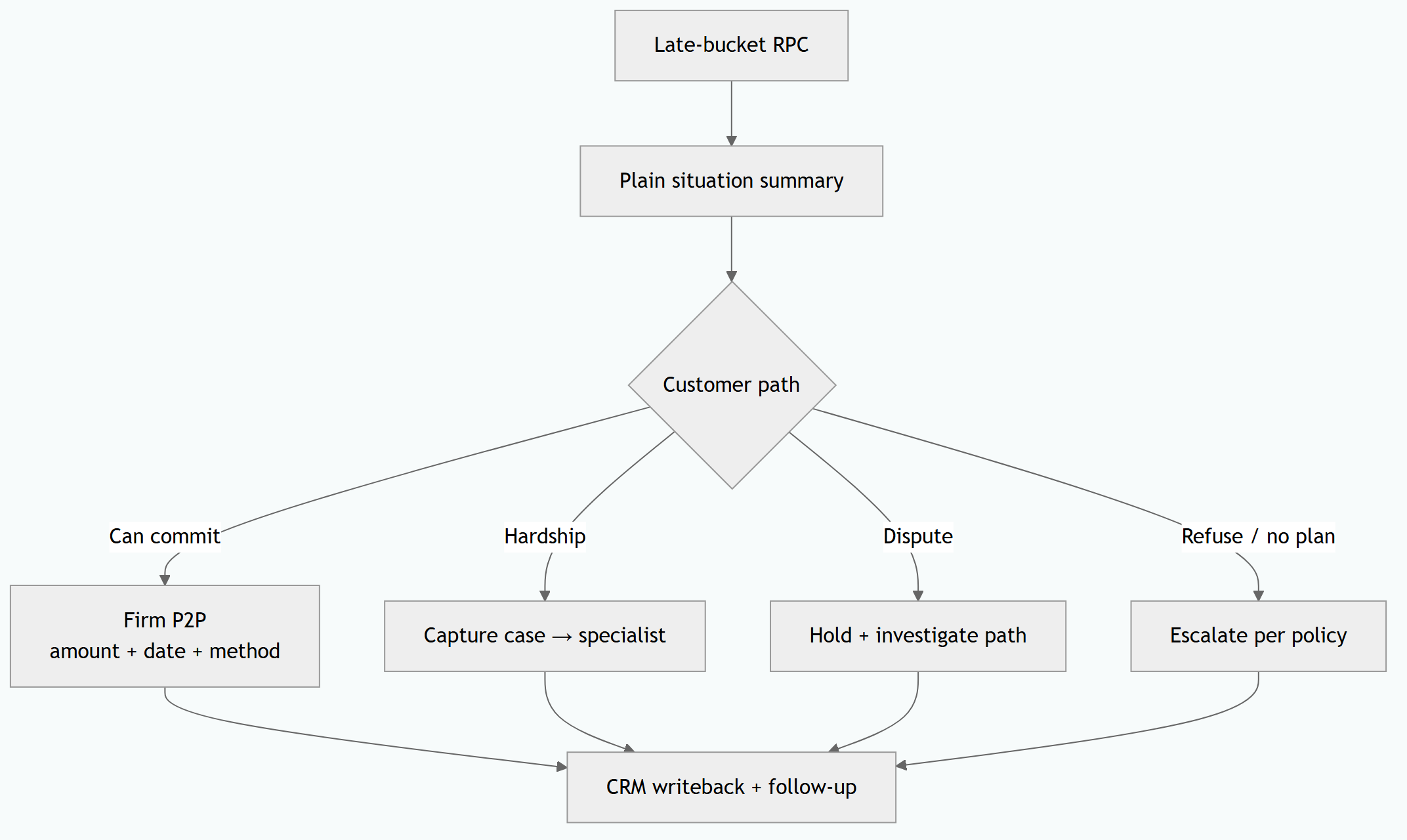
Late bucket — firm P2P with options
Intent: Clarity. Document choices. Protect compliance.
Typical moves:
- Confirm RPC thoroughly before details
- State the situation plainly (overdue, options available)
- Capture P2P or hardship / dispute routing
- Avoid threats your policy can’t support
- Always leave a next-action timestamp in CRM
Broken-promise retries — the second conversation
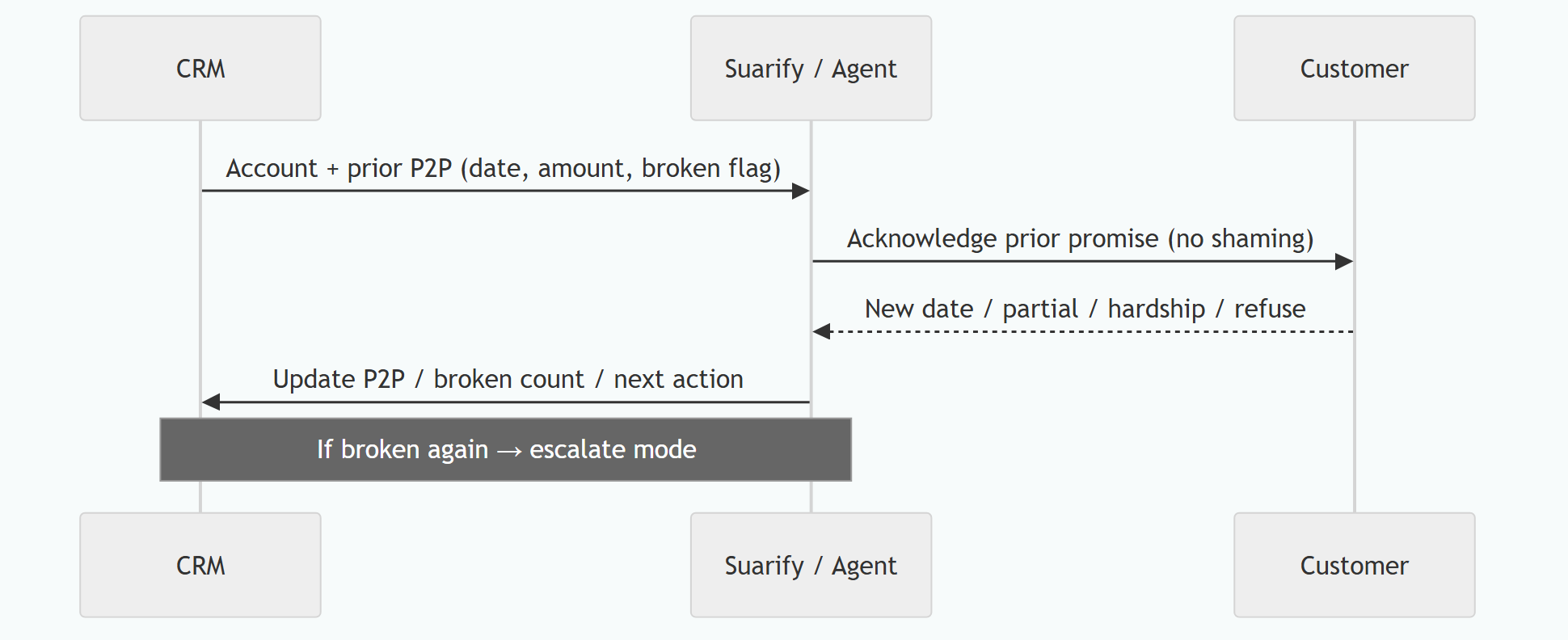
A broken P2P is not a first reminder. Customers already said they would pay. Restarting with “just checking in…” trains them that promises are cheap.
Retry ladder (example)
- Same-day / next-day soft check after miss (channel may switch: call → SMS → call)
- Renegotiate once with a nearer date or partial if policy allows
- Escalate tone and ownership (supervisor path / different agent mode)
- Policy action (hold benefits, formal notice, field visit — jurisdiction dependent)
Language that works (and what to avoid)
| Prefer | Avoid |
|---|---|
| “We had a payment arranged for Thursday — did something change?” | “You lied / you broke your promise” |
| “What date can you commit to now?” | Endless open-ended sympathy with no ask |
| “I can note a partial of X by Friday — does that work?” | Inventing discounts you can’t honor |
| “I’ll set a follow-up for after that date.” | Calling again the same day with identical soft script |
Measurement that actually improves scripts
Track these per bucket (not only portfolio averages):
- P2P rate — % of RPC that produce a dated promise
- Kept-promise rate — % of P2Ps paid by date
- Broken-promise recovery — % recovered on retry 1 / retry 2
- Time-to-cash after first RPC
- Complaint / dispute rate after firm scripts
If kept-promise rate is low, the script is getting false yeses. Fix the close (confirm amount + date + method), not only the opener.
How Suarify runs this ladder
Suarify is built so bucket and broken-promise state drive call mode, not a static IVR tree.
1) Dynamic mode by CRM fields
Drive agent behavior from live account context:
dpd_bucket→ early / mid / late script packprior_p2p_broken→ broken-promise modelanguage,product,dispute_flag→ routing and tone
Same campaign family, different conversation — without rebuilding dialer lists by hand.
2) Self P2P capture on the call
Instead of “please try to pay,” the agent (human or AI) can:
- Propose and confirm a date
- Capture amount / partial
- Speak the confirmation back
- Write structured fields to CRM immediately
3) API writeback for follow-ups that don’t drift
Broken-promise workflows only work if the system remembers. With Suarify’s API / CRM integration:
- Pull prior P2P and broken count before dial
- Push new P2P, outcome codes, next-action date
- Trigger outbound retries when promises expire unpaid

Practical rollout checklist
- Define bucket ranges and allowed asks with compliance
- Write four script packs: early, mid, late, broken-promise
- Map each pack to a Suarify dynamic mode
- Require structured P2P fields (date, amount, method, broken_count)
- Automate post-promise follow-up — don’t rely on agent memory
- Review kept-promise rate weekly and tighten confirmation language
Closing
P2P is not a single sentence. It is a ladder: soft when early, negotiated when mid, firm when late, and deliberate when a promise breaks.
Suarify helps collections teams run that ladder with dynamic modes, self P2P, and CRM API writeback — so every retry has memory, and every ask matches the delinquency stage.
Related: The Delinquency Call Journey
Ready to modernize collections outreach? Explore Suarify or book a demo.
Malaysia AI collections cluster: AI Voice Collections Malaysia (pillar) · BNM & AI compliance · Cost vs agency